Christopher Durang | 1409 Playbill Café, Washington, DC
Director: Suzanne Richard
Cast: Suzanne Richard and Dan Via
Two actors. A back room in a bar. And very little idea that a theatre company was being born.
The Washington Blade described Richard’s performance as having “stunning intensity” and noted that visible disability brought additional vulnerability, strength, and tension to the role.
Andrew Lloyd Webber and Tim Rice | Clark Street Playhouse, Arlington, VA
Director: Suzanne Richard
Music Director: Tracy Olivera
Choreographers: Fred Michael Beam and Stefan Sittig
Sign Master: Monique Holt
Jesus Christ Superstar was reset in the political and media world of 2004. Jesus, played by wheelchair-using actor Rob McQuay, became a grassroots presidential candidate whose movement was transformed by politics, celebrity, media, and power.
Bertolt Brecht | Round House Theatre Silver Spring
Co-Directors: Grady Weatherford and Monique Holt
Music: Fahir Atakoglu
With Brecht’s The Caucasian Chalk Circle, Open Circle pushed beyond simply putting disabled and non-disabled actors together onstage.
Co-directors Monique Holt and Grady Weatherford built American Sign Language, spoken language, movement, music, and physical storytelling into the production. Metro Weekly praised Open Circle for adding “fresh artistic layers” to Brecht’s work.
Clare McIntyre | 1409 Playbill Café
Director: Suzanne Richard
Open Circle returned to the intimacy of the Playbill Café for Clare McIntyre’s Low Level Panic, a play about three young women wrestling with sexuality, pornography, fear, fantasy, and the ways women are taught to see themselves.
Casting disabled and non-disabled women raised a rarely explored question: why were disabled women so seldom allowed onstage to be sexual, frightened, funny, angry, messy, or desirous without disability itself becoming the subject?
DC Theatre Review wrote that Open Circle had succeeded in “bringing overdue issues to the stage and the stage to everyone.”
Andrew Lloyd Webber and Tim Rice | Round House Theatre Silver Spring
Director: Joe Banno
Assistant Director: Suzanne Richard
Choreography: Liz Lerman Dance Exchange
With Evita, Open Circle continued exploring how an integrated company could shape a large-scale musical from the beginning.
Joe Banno staged the production on a long strip of playing space with audiences facing one another across it, making Eva Perón’s rise feel at once like a political rally, parade, and nightclub.
The Liz Lerman Dance Exchange created choreography from the bodies, abilities, and movement vocabularies of the artists in the room, rather than creating movement for one kind of body and adapting it afterward.
The Washington City Paper described the results at their best as “vital and energizing and new.”
The relationship with Dance Exchange became an important part of Open Circle’s artistic development.
Open Circle’s work was also beginning to move beyond its regular production season.
For the VSA arts Start with the Arts Family Festival, Open Circle was commissioned to create a concert version of You’re a Good Man, Charlie Brown at Union Station.
Director: Suzanne Richard
Music Director: Jason McCool
Pianist: Stuart Weich
That same year, Open Circle consulted with Liz Lerman Dance Exchange on The Farthest Earth from Thee: A Suite of Sonnets, a VSA arts commission bringing together Shakespeare, movement, video, and dancers with and without disabilities.
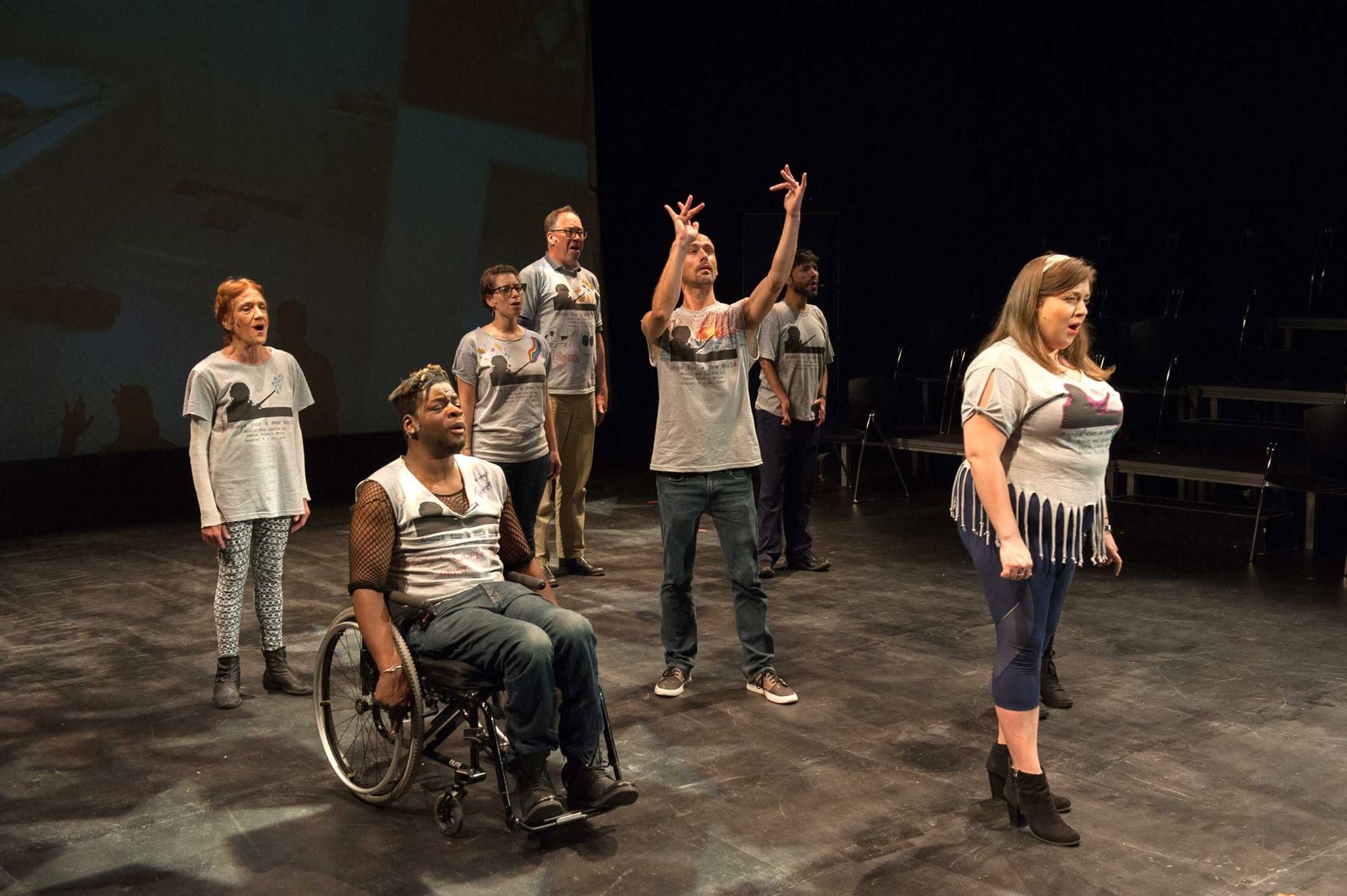
Jason Robert Brown | Round House Theatre Silver Spring
Director: Suzanne Richard
Music Director: Zak Sandler
Choreographers: Shula Strassfeld and Peter DiMuro / Liz Lerman Dance Exchange
ASL Master: Monique Holt
Rather than present Jason Robert Brown’s song cycle as a revue, Open Circle created a narrative about two soldiers serving in Iraq and the families and communities affected by the war.
American Sign Language, choreography, projections, music, and spoken storytelling were woven together throughout the production. The Washington Post called it “smartly staged” and “visually striking.”
The Washington City Paper singled out the collaboration between Monique Holt and choreographers Shula Strassfeld and Peter DiMuro. As Brown’s music built through a series of chords, the ensemble’s ASL and movement built with it visually. The critic called the effect “thrilling.”
It was a clear example of an artistic practice Open Circle had been developing since Superstar: American Sign Language is part of the visual and rhythmic vocabulary of the stage.
Paul Sills | Round House Theatre Silver Spring
Co-Directors: Suzanne Richard and Ian Armstrong
ASL Master: Jill Owens
Movement Collaboration: Liz Lerman Dance Exchange
Paul Sills’ adaptations of Grimm’s fairy tales and Aesop’s fables were placed in the aftermath of a devastating flood. Survivors waiting for rescue passed the time telling stories, turning the wreckage around them into characters, objects, and imaginary worlds.
The ensemble included Deaf, disabled, and non-disabled performers, with storytelling moving fluidly between American Sign Language and spoken language.
The Washington Post Express praised the versatility of the cast and the production’s “near-boundless inclusion.”
Capital Fringe Festival | Flashpoint’s Mead Theatre Lab
Director: Suzanne Richard
Music Director: Stuart Weich
For the Capital Fringe Festival, Open Circle created a cabaret around one central question:
How do people communicate—and what do they have to say?
Disabled and non-disabled performers explored that question through music, American Sign Language, spoken language, and performance.
Silver Spring Black Box Theatre
Director: Suzanne Richard
Music Director: Jake Null
Choreographer: Jen Bevan, collaborating with Dance Exchange artists Matt Cumbie and Cassie Meador
Tommy: Russell Harvard
Voice of Tommy: Will Hayes
After a hiatus from full-scale production, Open Circle returned with a musical whose central metaphor demanded examination.
Pete Townshend’s Tommy revolves around the famous “deaf, dumb and blind kid.” Open Circle cast Deaf actor Russell Harvard as the adult Tommy, with Will Hayes providing Tommy’s sung voice.
The concept was dubbed:
“The Metaphor Strikes Back.”
One moment captured the idea.
Throughout the story, Tommy has been bound to his reflection in the mirror. When he finally turns away from it and communicates for the first time, Tommy speaks in American Sign Language. His now-abandoned reflection becomes his voice.
The Deaf character—not the metaphor—owns the moment.
The production integrated American Sign Language throughout, along with accessible audience seating and audio description on demand.
Silver Spring Black Box Theatre
Written by: T. Chase Meacham, Rob McQuay, and Suzanne Richard
Director: Suzanne Richard
Music Director: Jake Null
Assistant Music Director: Stuart Weich
Choreography: Dance Exchange / Kelly King
Producer: Paula Sweeney
Fourteen years after Laughing Wild, Open Circle looked back.
To REACH the Unreachable Star brought together material from Jesus Christ Superstar, The Caucasian Chalk Circle, Evita, Songs for a New World, and The Who’s Tommy, placing Open Circle’s history alongside the larger history of the disability rights movement.
During the pandemic, Open Circle partnered with Woolly Mammoth Theatre Company around Mike Lew’s Teenage Dick, a darkly comic reimagining of Richard III centered on disabled characters.
Before Woolly’s production arrived in Washington, Open Circle presented an online benefit reading directed by Monique Holt, and Woolly subsequently named Open Circle an official partner for its DC engagement.
The collaboration reflected another part of Open Circle’s role: not only producing its own work, but partnering with other professional theatres around disability-centered work and artists.
In 2024, Open Circle Theatre and playwright/composer Lisa Sniderman took The Grieving Project into a residency at The Voxel in Baltimore to create a proof of concept for a truly hybrid theatrical experience.
Sniderman participated remotely through a telepresence robot while the team experimented with ways for remote and in-person artists and audiences to inhabit the same theatrical event.
The goal was never simply to livestream a performance to someone watching alone at home.
It was to explore whether a remote audience could watch in community with the audience inside the theatre, sharing the same event, interacting with one another, and having agency and presence within the experience even while entering from different physical spaces.